
.png?width=50&name=Untitled%20design%20(5).png)



Jump To Registration
In school districts across New Jersey and the nation, a revolution is underway. Changes in communication and problem-solving practices are placing educator well-being at the heart of student success. In the center of this movement is the NJ LMC’s partnership with Educators Thriving, an organization dedicated to helping schools create conditions where educators can flourish.
The road to well-being
Educators Thriving, was founded on the simple but powerful belief that every educator can and should experience well-being to reach their full professional potential. The organization works with schools, districts, unions, and regional agencies to turn that belief into reality through empowering individuals and transforming the systems that surround them.
Educators learn to build resilience and balance through Educators Thriving workshops. Their programs provide all staff with supporting strategies that sustain well-being and professional joy through coaching focused on core values of communication, adaptability, and self-care.
Educators Thriving Co-Founder and Head of Research, Hailie Fox PhD says, “The impact of this work has been substantial across our partner organizations. Our participants are reporting greater job satisfaction, stronger staff retention, and overall higher well-being.”
Educators Thriving also helps school leaders understand and act on the conditions shaping their educators’ experiences. Using data from their custom Educator Well-Being Measure, a survey developed in collaboration with the American Federation of Teachers (AFT) in 2022, Educators Thriving guides school and district leaders to identify strengths and address challenges. The goal is to cultivate supportive cultures where educators feel seen, trusted, and valued.
Partnership provides evidence of impact
The New Jersey Labor Management Collaborative (NJ LMC) required a consistent, research-aligned way to show the impact of its work across all sites. Early successes were promising, but replicable evidence was needed to demonstrate what NJ LMC teams were hearing and observing about increased staff wellness.
Educators Thriving’s custom Educator Well-Being Measure offered exactly what was needed, especially finding connections between workplace well-being and staff retention. The data helped confirm that dedicated LMC work is creating real, material improvements, like better wellness, reduced stress and other meaningful gains including financial support in certain districts.
Mike Ritzius, NJEA liaison to the NJ LMC explained, “Partnering with Educators Thriving provides us a research-based measure to assess and draw correlations between LMC implementations and how people actually feel at work,” Wellness is one of the impacts brought in by an LMC. Ritzius says “Members share that they no longer get the Sunday Scaries and don’t dread being at work anymore.There's a new found sense of agency to overcome challenges.”
What the data reveals
Educators Thriving’s well-being measure is uniquely educator developed and driven. Survey questions were generated through more than 100 hours of focus groups with educators across roles including teachers, paraprofessionals, custodians, and counselors. Every unit is represented, and the resulting data paints a clear picture: responsive leadership and supportive culture are significant predictors of overall staff well-being, retention, and job satisfaction.
When educators feel their administrators take concerns seriously, trust them to do their jobs, and help them problem-solve - well-being rises. It’s a reminder that the tone and trust set by leadership are not abstract ideals. They are measurable and powerful drivers of educator engagement and success.
The power of collaboration
Among the organization’s most striking findings is the impact of collaboration among educators and between labor and management. Across years of data and dozens of partnerships, Educators Thriving has consistently found that when educators spend more time collaborating with colleagues, they report higher overall well-being.
This insight has grown into a deeper exploration of the structured partnerships between unions and district leaders in NJ and nationwide. Working together, these groups can create more responsive, inclusive systems that benefit both educators and students.
In 2025, Educators Thriving partnered with the National Education Association (NEA) to test these relationships through a national pilot study. Districts in New Jersey, California, Idaho, and Minnesota helped researchers investigate whether educators in collaborative systems experienced better outcomes.
The answer was an emphatic yes! In districts where collaboration was strongest, educators reported significantly higher well-being, stronger intentions to stay, and greater job satisfaction. They were also more likely to describe their schools as great places to work.
In contrast, schools that had not yet developed district wide collaborative relationships saw lower well-being scores. There were some outliers in the study, however, that had smaller collaboration groups in place. “The school site is really where people experience their work,” says Fox. “Even if collaboration isn’t strong district-wide, when a principal is responsive and inclusive, we still see significant gains in staff well-being.”
Collaboration in practice
Clifton Public Schools provides a powerful example of a mature LMC district that has made remarkable gains in staff wellness and job satisfaction. Clifton has spent years cultivating shared practices between the union and district leadership, beginning with Clifton Education Association (CEA) Past-President, Lori Lalama and current Superintendent Danny Robertozzi. Clifton educators consistently describe a sense of unity and shared purpose that translates directly into higher well-being.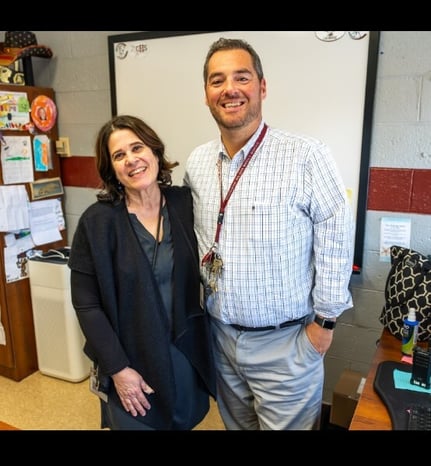
Recently, when Clifton Public Schools partnered with Educators Thriving, the messaging resonated immediately. “We
went to the 2024 NJ LMC Pre-Con in Atlantic City and just loved what they were saying,” recalled current CEA President, Shari Merola. “We knew right away that this was what our district needed.”
Merola emphasized that Clifton’s partnership with Educators Thriving isn’t a one-and-done effort. “This work is ongoing. We’re planning more sessions throughout the year so it’s not just a box to check,” she explained. “We want educators to keep hearing about these strategies so the practice sticks.”
Merola and Woodrow Wilson Middle School Principal Andy Jaeger helped launch the district’s LMC which was specifically designed to connect ideas with action. “To start, people were approached who wanted to really make things happen,” she said. “It was incredible to see the ideas come to life.” Over time, their success earned Merola and Jaeger the responsibility of helping lead the district’s broader collaborative effort.
The mindset of focusing on results inspired the creation of a team they call the GSD Team - short for Get Stuff Done. “It’s our way of keeping the energy up and turning ideas into action,” Merola said. “We really had a lot of momentum last year, and even though summer can slow things down, we always pick it back up once school starts again.”
For Merola, an art educator, collaboration is inherently connected to her artistic nature. “Artists are born collaborators,” she explained. “We love sharing ideas, giving feedback, and building on each other’s creativity. That spirit translates perfectly into how our team works.”
She acknowledges that sometimes not everyone is comfortable with the open, honest feedback that comes with collaboration. “Sometimes people new to the team take feedback personally,” she said. “But we always remind them that this isn’t about the individual, it’s about the idea. We’re here to make things better together.”
That sense of trust is what keeps Clifton’s collaboration strong. “Everyone knows who should make which call and when,” Merola said. “That trust keeps communication open and prevents misunderstandings.” Even with the current educator crisis, she remains optimistic. “People want to be here. We’ve built something that works and we’re not letting that go.”
Turning data into action
Educators Thriving helps partners like Clifton use data for action. Each engagement begins with a baseline survey that highlights both district-wide and school-level trends. From there, leaders and staff co-design supports that strengthen collaboration, communication, and culture.
In Clifton, Educators Thriving has partnered with both district leaders and school sites to sustain the culture of collaboration. At some sites, that means targeted professional development for administrators, or coaching for teams navigating cultural challenges. At others, it means celebrating and scaling what’s already working well.
Clifton’s Assistant Superintendent of Curriculum & Instruction, Janina Kusielewicz was pleasantly surprised by the wellness survey results. “We were encouraged to hear how supported our educators feel from administration and from their association,” she says. The survey has also helped district and school leaders identify areas where staff still want more support.
“Though the initial data is encouraging the work isn’t done,” Kusielewicz said. “We were pleasantly surprised with the results but that doesn’t mean we can rest on our laurels. We need to continue this work to help retain our staff while balancing their well-being with our students’ needs.” She notes that Clifton’s record of being above national averages is motivation to keep improving, not a signal to stop.
Kusielewicz firmly believes that happy educators equal happy kids. “We know that educators experience less stress when they feel supported and have the internal and external tools they need,” she said. “That is also when students have the best outcomes.”
Leading with collaboration
Educators, school leaders, and unions are asking: How can we build systems where trust, communication, and shared responsibility are the norm? When educators thrive supported by collaborative and responsive systems, students will thrive too.
NJEA President Steve Beatty has made educator wellness and retention a focus of his term. “What this work shows, plain and simple, is that educator well-being is a foundational element of successful schools and positive outcomes for students,” Beatty said. “When labor and management work together, we are resourcing the strongest tools possible to ensure that our public schools are the best in the nation.”
To learn more about Educators Thriving and their work supporting educator well-being, please visit their website at www.educatorsthriving.org.